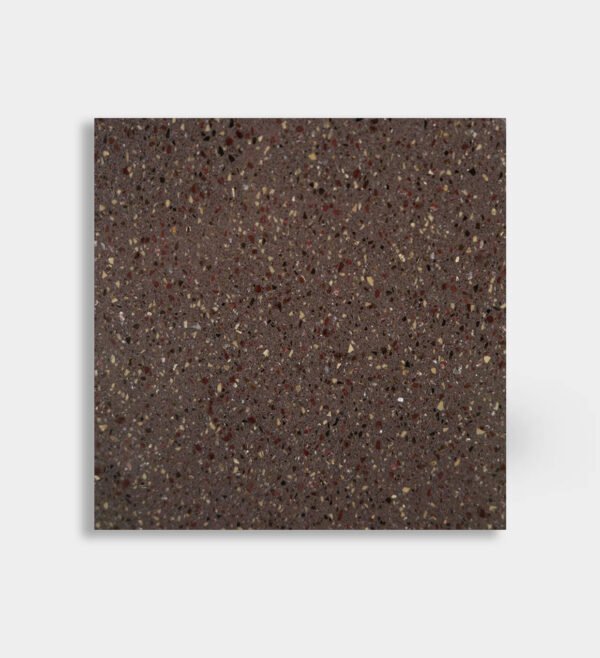
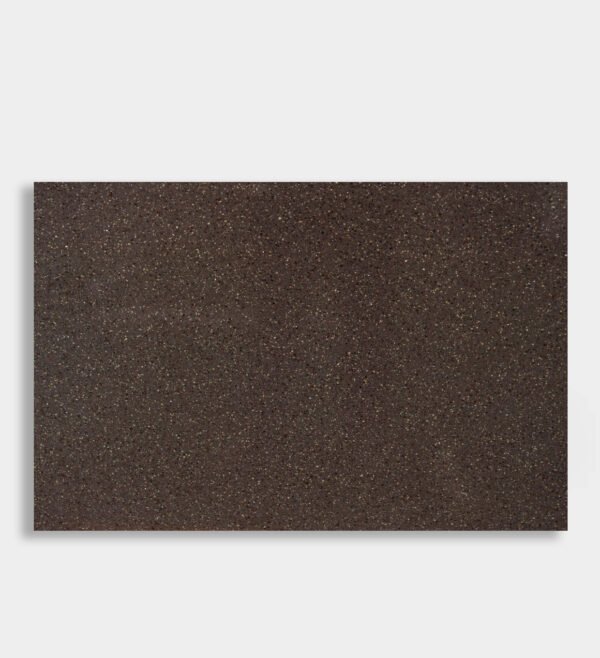
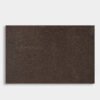
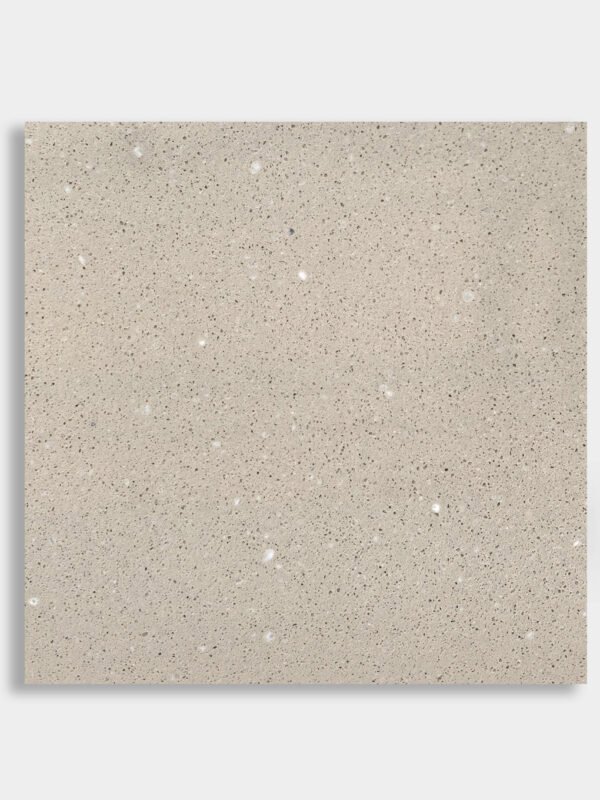
This terrazzo uses brown cement as its base, a color similar to tree bark or old wood—warm and heavy. Mixed inside are crushed natural marble chips in three colors: red, black, and yellow, all measuring under one centimeter, making them fairly fine aggregate.
Because the chips are small, they are densely packed. The red chips read warm, the yellow ones brighter, and the black ones darker. The three colors are mixed together without a fixed pattern, but because they are all natural stone, each piece has a different shape—some round, some flat, some with sharp corners. Set into the brown cement, they look from afar like a layer of colored fine sand scattered on a dark ground. Up close, you can see the natural veining of each tiny stone, some with patterns, some with uneven color depth.
It is an inorganic, cement-based terrazzo, held together by Portland cement. Once the cement sets, the slab is heavy and dense, feeling harder underfoot than resin-based boards. Its compression and wear resistance are good, suitable for high-traffic areas like living rooms, corridors, and shopping malls. However, cement naturally has pores that allow liquid penetration, so the surface must be sealed by crystallization after installation, followed by periodic waxing. Daily cleaning is simple—just wipe with a damp mop.
The brown base itself hides dirt well. Paired with the fine red, yellow, and black chips, the tone is warm and earthy. At home, it works for living room and dining room floors, as well as kitchen countertops. In commercial spaces such as cafés, restaurants, showrooms, and guesthouse lobbies, the warm color helps people relax. Large slabs can be cut to site dimensions, minimizing joints. Once laid and properly maintained, it is ready for normal use.
In plain terms, this is a cement-based terrazzo with a brown base and fine red, yellow, and black chips. The slab is solid, the color is warm, and the hardness is high—but remember to seal and wax it, or it will show age over time.



Reviews
There are no reviews yet.