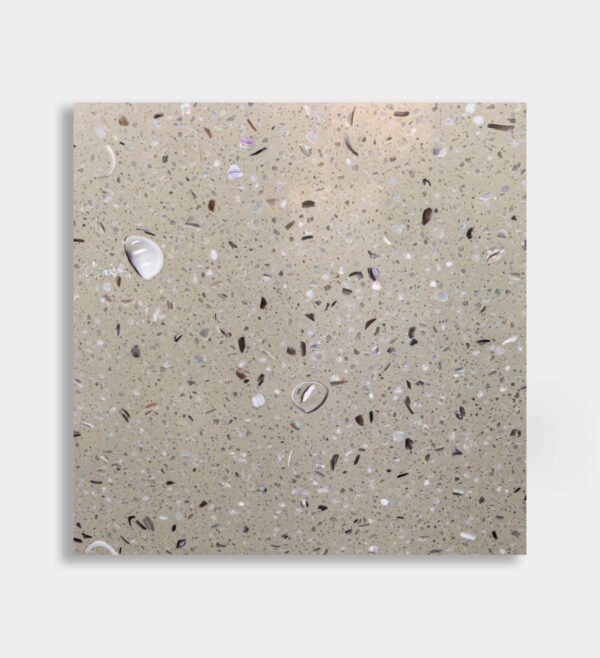
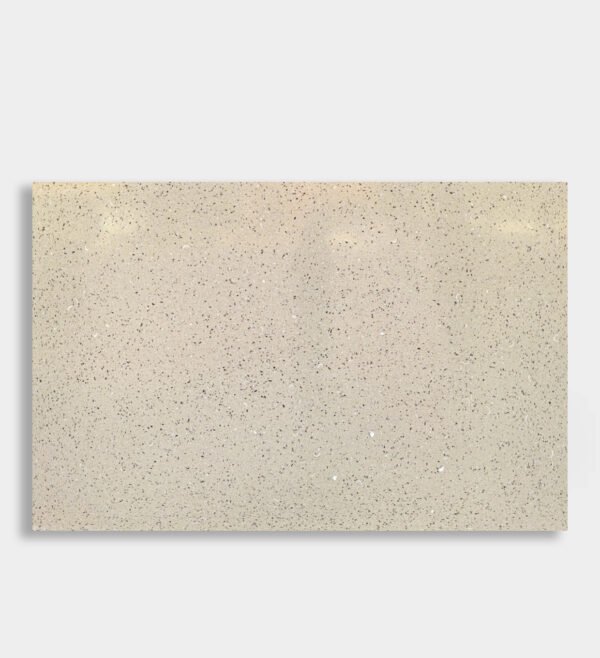
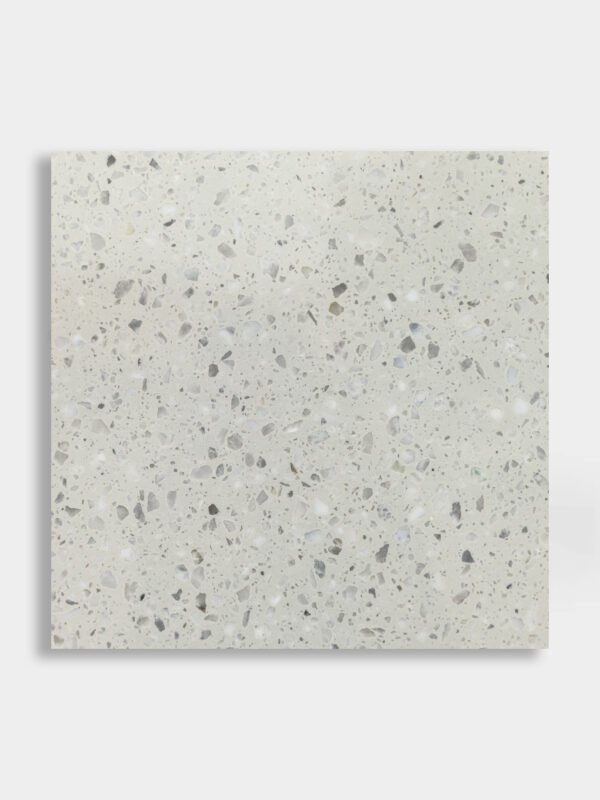
The base is tinted beige cement, mixed with crushed natural seashells ranging from 0.5 to 3 cm. These are not ordinary stone but sea shells harvested and broken down, some still retaining the pearlescent luster of their nacreous layers, casting faint iridescence against the warm beige cement.
Seashells differ from marble. They are lighter, thinner, and more irregular in shape. Some carry natural curvature like small fan segments; others are fractured into sharp, angular edges. The 0.5 cm fragments fill the gaps, while the 3 cm pieces stand out, embedded in the warm yellow cement like shells washed up by the tide and pressed into sand. Under light, the shell surfaces reflect a subtle pearlescent glow that ordinary stone cannot achieve.
It is an inorganic terrazzo bound by ordinary Portland cement. Once set, the slab is heavy and dense, feeling solid underfoot with compression and wear resistance exceeding resin-based alternatives. However, cement has inherent porosity, allowing liquid penetration. Therefore, the surface must be sealed by crystallization after installation, followed by periodic waxing to maintain its finish. Daily cleaning requires only a damp mop; avoid strong acids that can damage the surface.
The warm-toned surface carries a natural marine quality. It suits living rooms, balconies, and bathroom walls at home—the pearlescent quality of the shells makes bathrooms appear clean and bright. Commercially, it fits coastal guesthouses, seafood restaurants, spa clubs, and craft studios, where the distinctive material creates immediate atmosphere. Large slabs can be cut to size, though because shells are more brittle than stone, cutting requires care to prevent edge chipping.
In short, this is a cement-based terrazzo with a beige base and embedded natural shell fragments. It offers pearlescent warmth and sufficient hardness, but as a cement product, ongoing maintenance cannot be neglected.



Reviews
There are no reviews yet.