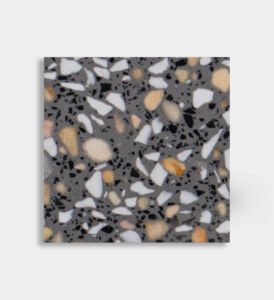
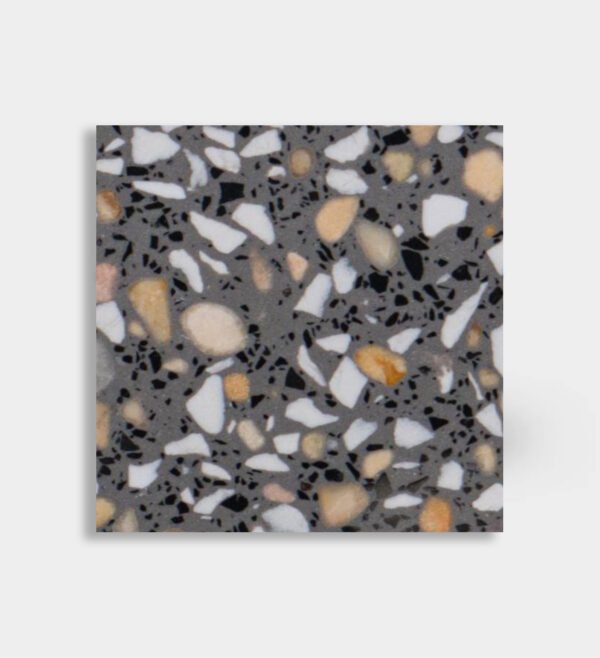
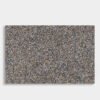
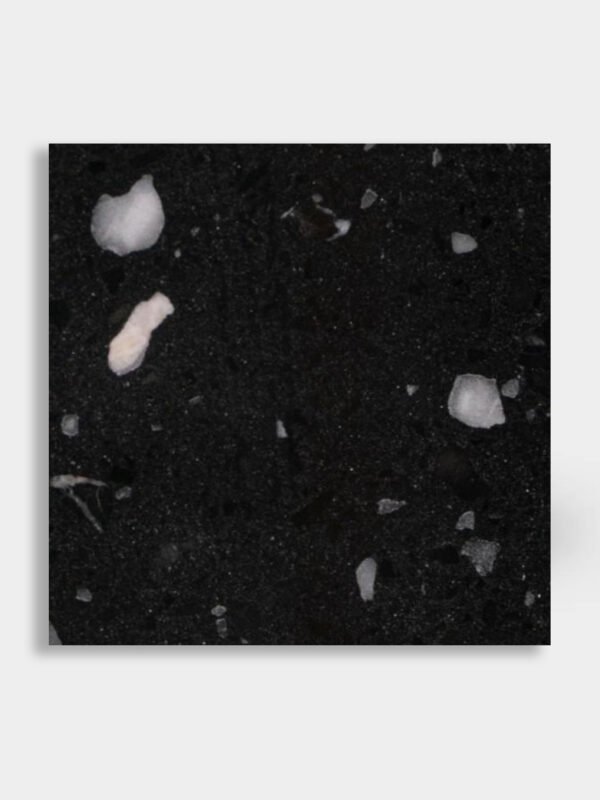
The surface of this gray resin terrazzo is covered with a dense layer of extremely fine black mineral grains, measuring just 0.1 to 0.5 cm—like coarse salt or fine sand evenly scattered across the gray base. Between these fine black particles sit white and beige natural marble fragments ranging from 1 to 3 cm, noticeably larger and serving as the visual focal points.
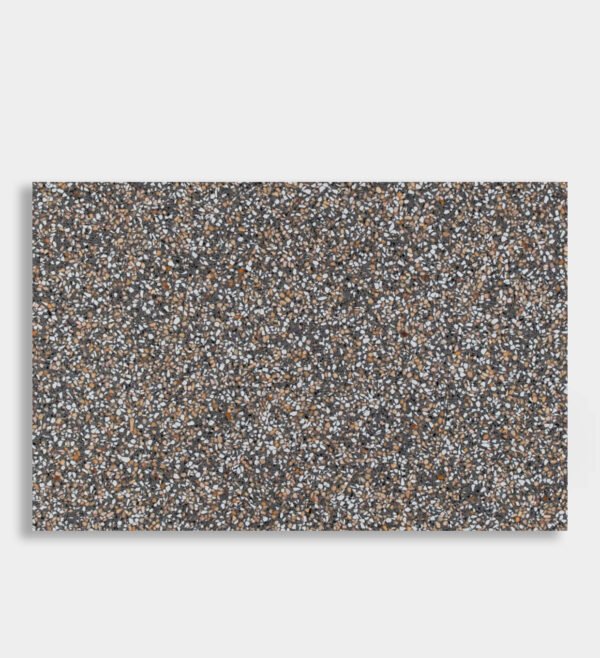
This coarse-and-fine pairing gives the surface a layered texture of “sand” and “stone.” The dense black fine grains deepen the gray base while making the white and beige fragments appear brighter. The larger fragments are irregular in shape—some with edges rounded by water, others still sharp from quarrying. The white fragments read cool, the beige ones warm; the two tones alternate against the black sandy ground, looking from afar like pebbles scattered on a shallow beach, and up close each fragment reveals its own natural veining. Because the fine grains fill the gaps between the large fragments, the surface appears solid without visible depressions or voids.
The resin casting process locks these different-scale aggregates firmly in place. The 0.1–0.5 cm fine grains act as filler and transition, wrapping the 1–3 cm fragments tightly. The finished product has low water absorption and a dense structure. After grinding and polishing, the sand-like black grains and the larger marble fragments sit on the same plane, feeling smooth underfoot with no height difference. Daily walking will not snag shoes, and dust and liquids do not easily hide in crevices.
In practical use, this surface is quite durable. The resin itself carries some flexibility, unlike cement’s brittleness, so edges are unlikely to chip during cutting and installation. The surface hardness is sufficient for daily home use or general commercial spaces; dragging tables and chairs will not easily leave visible scratches. The stain-resistant layer blocks most tea and oil stains from penetrating. The gray base is inherently more dirt-resistant than pure white, and with the black fine grains providing additional camouflage, everyday dust is not very noticeable—mopping once or twice a week keeps it clean.
It suits continuous spaces such as living rooms, corridors, and open kitchens, and can also be used for bathroom walls or washbasin countertops. In commercial settings, tea houses, bookstores, and small galleries will find this surface quiet and textured. Large slabs can be cut to size, minimizing joints, and after laying no special maintenance is needed—just clean and use.
Gray base, black sand, white and yellow stone—none of the three tones are loud, but together they create visual interest. The surface is dense, the foot feel is smooth, it wipes clean easily, and it is a flooring material built for long-term use.



Reviews
There are no reviews yet.